
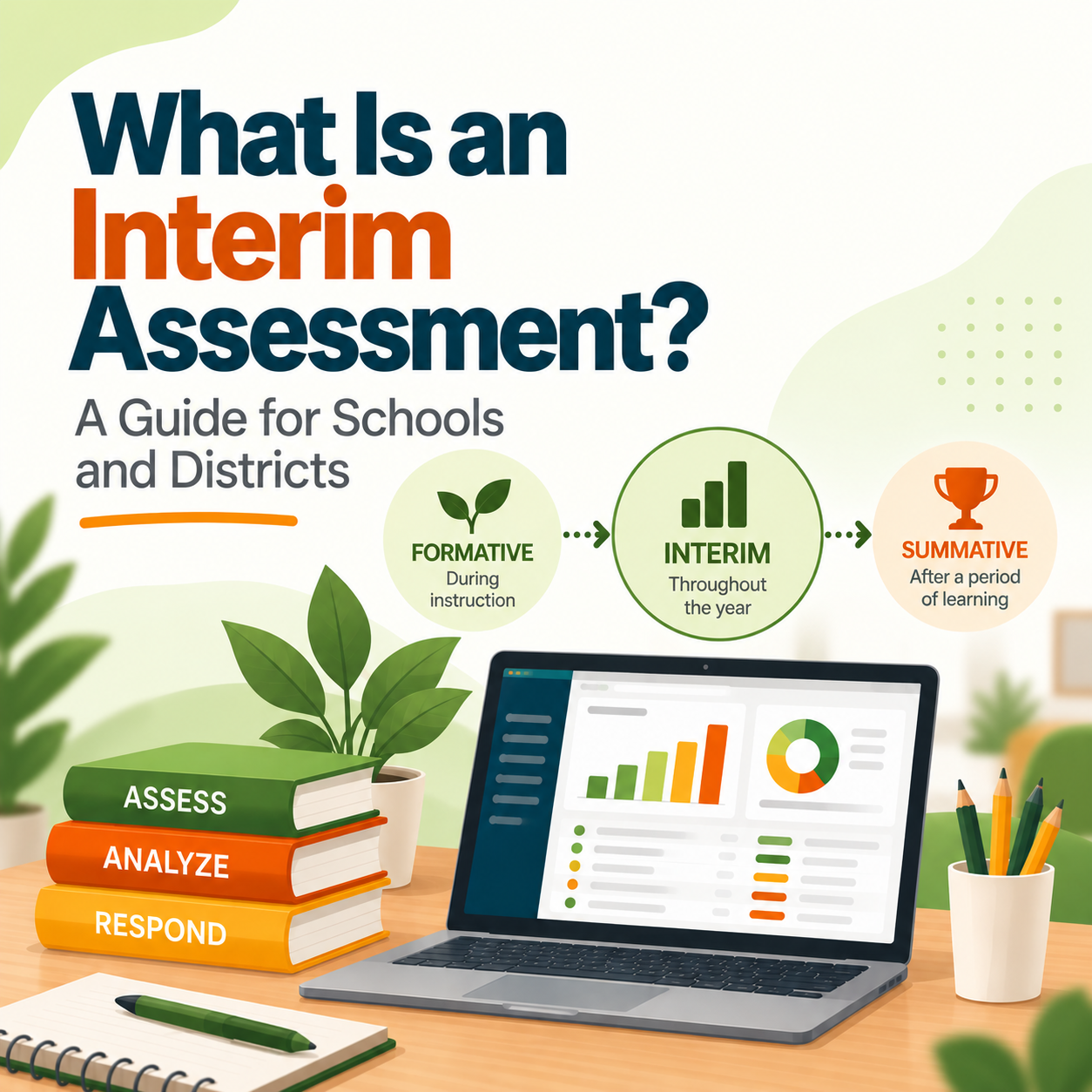
Schools and districts use assessments throughout the year for different purposes, from quick classroom checks to end-of-year state tests.
Between those are interim assessments, often called benchmark assessments. Schools and districts may also use common assessments to measure learning consistently across classrooms or schools. These periodic assessments help educators understand how students are progressing while there is still time to respond.
The terminology isn’t always consistent. What’s more important than the name is the purpose: giving educators useful information about student learning while there is still time to act on it.
What Is an Interim Assessment?
An interim assessment is administered periodically during the school year to measure student learning against a defined set of academic expectations.
Unlike an end-of-year summative assessment, an interim assessment happens while instruction is still underway. Results can help educators identify strengths, uncover learning gaps, and make instructional decisions about what should happen next.
For example, a district might administer a common mathematics assessment several times during the year. Educators can then examine performance by student, classroom, school, question, or standard to identify where additional instruction or support may be needed.
Interim assessments are generally less frequent and more standardized than the formative assessment that happens during everyday classroom instruction. They may also be administered consistently across multiple classrooms or schools.
Interim Assessment vs. Benchmark Assessment
What’s the difference between an interim assessment and a benchmark assessment?
Often, there isn’t one.
Many schools, districts, states, and assessment providers use the terms interchangeably. Sometimes benchmark assessment is used more specifically for an assessment that measures whether students have reached a particular level of performance or are on track toward an academic goal.
But for schools and districts, the more useful questions are:
What are we trying to learn? And what decisions will we make with the results?
Those questions should drive how an assessment is designed and used.
Interim vs. Formative vs. Summative Assessments
One way to understand interim assessments is to look at where they fit within a broader assessment system.
| Assessment Type | When It’s Used | Primary Purpose | Example |
|---|---|---|---|
| Formative | Continuously during instruction | Adjust teaching and learning in the moment | Exit ticket, classroom questioning, quick check for understanding |
| Interim / Benchmark | Periodically throughout the year | Measure progress and inform instructional decisions | Quarterly common assessment, midyear benchmark |
| Summative | After a defined period of learning | Evaluate what students learned | End-of-course exam, end-of-year state assessment |
These categories aren’t determined solely by what an assessment looks like. The same assessment could serve different purposes depending on when it is administered, what it measures, and how educators intend to use the results.
What Is a Common Assessment?
A common assessment is an assessment administered to multiple groups of students, such as across classrooms, grade levels, schools, or an entire district.
For example, all Algebra I students in a district might take the same assessment after completing a particular portion of the curriculum.
Because students take a common assessment, educators can look beyond an individual classroom and ask:
- Which standards have students mastered?
- Where are students struggling?
- Are there meaningful patterns across classrooms or schools?
A common assessment can also be an interim assessment. Many district interim assessment systems use common assessments to create a consistent picture of student learning across classrooms and schools.
Examples of Interim and Benchmark Assessments
Interim assessments can take different forms depending on what educators are trying to learn.
Examples include:
- Beginning-, middle-, and end-of-year benchmark assessments
- Quarterly district common assessments
- Standards-based interim assessments
- Common end-of-unit assessments
- Reading or mathematics benchmarks
- State-provided interim assessments
California, for example, provides optional Smarter Balanced Interim Assessments that schools can administer at locally determined points during the year. These include broader Interim Comprehensive Assessments and more focused Interim Assessment Blocks.
The right type of interim assessment depends on the information educators need and how they plan to use the results.
What Makes an Interim Assessment Useful?
Giving students an assessment doesn’t automatically produce useful information. Three things are particularly important.
1. Measure What Matters
Assessment questions should align with the standards, curriculum, and instruction students have experienced.
The response format should also match what students need to demonstrate. Sometimes selecting an answer is appropriate. Other times students may need to graph, construct, analyze, calculate, or explain their reasoning.
2. Make the Results Actionable
An overall score only tells educators so much.
Results become more useful when teachers and leaders can examine performance by student, question, standard, classroom, school, or other meaningful groups. The information also needs to arrive quickly enough for educators to act on it.
3. Have a Plan for What Happens Next
Perhaps the most important question should be answered before an interim assessment is administered:
What will we do differently based on what we learn?
Results might lead educators to reteach a standard, provide targeted intervention, adjust pacing, identify students ready for enrichment, or share successful instructional strategies across classrooms.
The goal isn’t simply to collect more data. It’s to turn assessment results into better instructional decisions.
How Schools Use Interim Assessment Data
Consider a district that administers a common Grade 6 mathematics assessment.
Overall performance looks strong, but a closer look reveals that students struggled with ratios and proportional relationships. District leaders can look for patterns across schools, school leaders can compare results across classrooms, and teachers can identify individual students who need support.
That might lead to reteaching, intervention, changes to instruction, or opportunities for teachers to learn from colleagues. Educators can then reassess to see whether those changes made a difference.

That’s more useful than simply knowing whether the average score was 72% or 76%.
Creating Common Interim Assessments With Edcite
For schools and districts building an interim assessment system, there doesn’t have to be a choice between purchasing a fixed benchmark assessment and having every teacher create assessments independently.
With Edcite, schools and districts can create common assessments around their own standards, curriculum, pacing, and assessment goals.
Educators can build assessments using a wide range of technology-enhanced question types, align questions to standards, distribute common assessments across classrooms and schools, and analyze student performance.
This gives schools flexibility over what they assess while creating consistency in how student learning is measured and analyzed.
At Princeton City Schools, for example, Teacher-Based Teams use Edcite to build shared assessments, review results together, and adjust instruction based on what students need next.
Teachers and leaders can then use the resulting data to understand performance and identify where students may need additional support.
Interim Assessment Should Lead to Action
A strong assessment system isn’t defined by how many assessments students take. It’s defined by whether those assessments provide information educators can actually use.
Interim, benchmark, and common assessments provide a view of student learning between everyday classroom assessment and end-of-year summative tests.
But the assessment itself is only the beginning.
The real value comes from what educators do with the results.
Build Better Common Assessments With Edcite
Create, distribute, and analyze standards-aligned common assessments across classrooms and schools, with the flexibility to build around your district’s curriculum, pacing, and assessment goals.
Leave a Reply